Sunday, November 10, 2013

The Problem with Dams

Problems with Dams
The Garrison Dam on Lake Sakakawea
Garrison Dam


Dams are a controversial since there are both benefits and problems that come with them. The benefits of dams include irrigation, recreation, flood control, and some generate electricity. Dams help farmers with irrigation for their lands, without them it would be harder to harvest enough water to spread to their crops. Another perk is recreation with dams. Recreation include skiing, camping, swimming, ect... Dams have control of how much water the release back into the river, this helps with flood control. One of the most beneficial aspects of dams is that some can generate electricity with the water pressure. Water would push propellers to generate electricity. 

However with all these benefits, there are numerous environmental concerns to think of.  Dams are imposing on an animals natural habitat. Dams  interfere with many animals/plants life cycle that could depend on floods and a naturally flowing river. Many dams don't include a bypass system for fish and other creatures to let them pass through the dam. This messes with their cycle and could kill them. Some dams also block fish from their spawning ground. 

Soil erosion is also a hazard with Dams. There is natural erosion that happens with sediment going downstream, however when it gets clogged by the dam, the normal sediment doesn't reach downhill. So downhill starts to erode. 

Dams in tropical areas can gather disease since water is blocked off from naturally flowing. Mosquitoes that harbor disease could be more prevalent.

So with positives come negatives. Dams are useful economically, but harms the environments ecosystem. 


Friday, November 8, 2013

China's Air Pollution

China's Smog
Poor visibility: A woman wearing a mask checks her mobile phone during a smoggy day on the square in front of Harbin's landmark church, in Heilongjiang province
Within the last decade or so, China's air pollution has sky-rocketed to the point where people wear masks in heavy smog. It's ridiculous. The population in China is around 1.351 billion since 2012 count according to Google. Just about 2 weeks ago a NASA satellite took pictures and a video of a city called Harbin (10 million population). The city was surrounded by smog. China smog

During heavy smog storms, China's schools close down. People in china are suffering in the smog that they produce. The government must pressure companies to reduce use of emissions or be more environmentally conscious in this economically driven society. They must put measures in place, set standards, and follow through with them. The public is getting restless with the pollution they live in since they have to deal with it everyday.

There was one case where there was a public outcry about an 8 year old having lung cancer from all of the smog. There is also a correlation to low sperm count and pollution.

Here's also an interesting opinion essay regarding the air pollution.

The air pollution is caused by the numerous coal factories, car emissions, and other considerable factors.

Tuesday, November 5, 2013

News Tuesdays


Happy Tuesday everyone! 


Here's a very interesting short article on the energy consumption in China. They ask if Dams do more harm than good. China's main drive is to prosper economically and by doing that people need more energy. However having more energy has the damaging effect of near by ecological systems.


According to a study done by NASA, deforestation has increased dramatically in Madagascar, China, and Bolivia. It's interesting how they use newer technology produced by NASA to detect forest loss. A sensor called Spectroradiometer (MODIS) was used to detect at least 40% of loss greenery around the world .

Researchers are looking at dog tails to determine their mood which could help owners and vets care for them. They gather information from the wags of either anxious or happy dogs. 


Saturday, November 2, 2013

Big Tuna In Trouble


Bluefin Tuna In Trouble

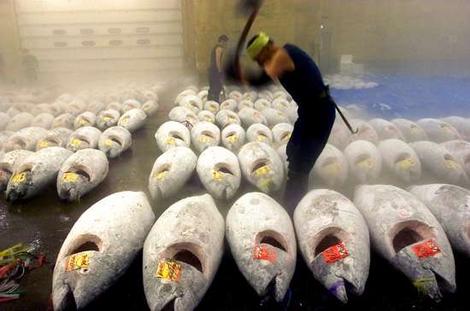
Bluefin Tuna are in trouble. Their numbers have been decreasing due to over-fishing. It's gotten to the point where Bluefin Tuna are in such demand that the price for them is high. Just this January, a Bluefin tuna sold for 1.76 million dollars in Tokyo. That's a ridiculous amount, but it's because Bluefin tuna are integrated in many meals like sushi. Primarily, Bluefin tuna are used in Japanese delicacies like sushi and Japan consumes 80% of bluefin caught around the world. The largest players that catch them are Japan, South Korea, Mexico, and the United States. 


Just this year, they recorded that more than 96% of Pacific Bluefin Tuna are in decline. It's been a few years that Bluefin tuna are endangered, but as time goes on and as they reach critical endangerment, fisheries and tuna lovers will face hard times. The Bluefin tuna are being caught at their juvenile stage, before they can even reproduce. It takes between 4-8 years for Bluefins to reach sexual maturity. "Stocks of all three bluefin species —the Pacific, Southern and Atlantic — have fallen over the past 15 years amid overfishing" 

Here's a long article by the National Geographic that might put this whole theme of "overfishing" into perspective. 

Tuesday, October 29, 2013

News Tuesdays

News Tuesdays 

http://www.nytimes.com/video/science/100000002524020/sciencetake-what-makes-ticks-stick.html

To start of this weeks news Tuesdays, there's a very interesting short video about the tick. It's a video that shows how ticks stick to skin by bearing it's saw like jaws deep into the epidermis...

 Does it make your skin itch yet?
Carpenter bee     Sandra Rehan, University of New Hampshire
Moving on to more discovery type news, the BBC covered a segment that bees were extinct 66 million years ago, about the same time as the dinosaurs. What's interesting about this find is the fact that bees don't possess much diversity in their species... This might be a correlation with the extinction.  

A female epicephala moth pollinating a phyllanthaceae female flower
This is an interesting article touching on how female and male flowers have different senses that might give off different "rewards." This is interesting since the different sex flowers aren't as common as single sex.  They looked at epicephala moths and noted their behavior towards the flowers.

Monday, October 28, 2013

Coral Reef Bleaching- Underwater ecosystems in danger.

Coral Reef Bleaching


When scuba diving, you might have seen ghostly corals near the shoreline, this is mostly because the temperature of the waters in that area have risen. There are other factors that may play a role, but global climate change is the biggest contributing factor. Because of rise in temperature, the sudden change makes the corals stressed. When stressed the corals's algae leave them which urns then white. There is a vast amount of algae that are helping the coral survive. They help the corals produce food and photosynthesize. This change doesn't mean the corals are dead, but are stressed and on the verge of death. "In 2005, the U.S. lost half of its coral reefs in the Caribbean in one year due to a massive bleaching event." Corals have a limited range of temperatures they can live in. With global warming upon us, this exceedingly makes it harder for corals to survive since water temperatures are rising. 

So why are coral reefs important? 

Coral reefs house 25% of all marine life. Without corals, those marine life wouldn't have a house to protect them against predators. This decrease of housing could result in devastating population instability. Besides the ecosystem being in jeopardy,  it affects human jobs since the corals help support the fishing industry. 


Tuesday, October 22, 2013

News Tuesdays


IN RECENT NEWS..

Just last week, there was an Oarfish that washed on the shores of California. It's 14 feet and a deep sea creature. Once they autopsied the body, they realized it was pregnant at the time. It's just unclear on why the Oarfish died.
Australian scientists have found gold particles around the soil of eucalyptus tree's and in the leaves. It's interesting that precious metals like gold can be found in common leaves. "We've done a calculation, and found that we need 500 trees growing over a gold deposit to have enough gold in the trees themselves to make a gold ring," said Dr Lintern

Gold and other mineral deposits in leaf


There has been a recent discovery of a venomous crustacean. Out of the 70,000 species of known crustaceans, this remipede crustacean is poisonous. The remipede lives underwater and uses its poison liquefy its the prey.

Remipede

Sunday, October 20, 2013

More Shark Finning Info (Updated News)


Here's a great site that shows just how much the shark fin trade affects the population of sharks.
https://www.sharksavers.org/en/education/sharks-are-in-trouble/the-impact-of-the-shark-fin-trade/

Shark finning is not only cruel, but extremely wasteful.

sharkFinInfographic.jpg
Check out this quick video on Shark finning!
http://www.wired.com/wiredscience/2010/09/video-shark-finning/

News this year about shark finning:

Hong Kong has banned the use of shark fins in official banquets. There was a lot of pressure from the conservation groups, which was a Big step towards saving the sharks. The worry of this statement is the fact that it won't be placed timely. It could take up to 3 years and could have many complications. Only time would tell...

There is a campaign called " I'm FINished with Fins". This campaign has done great work with bringing awareness to shark finning. They announced that more than 360,000 people have participated in the campaign. Although as we all know, China has a large population and the pressure of shark finning needs to branch out though out China.

Saturday, October 12, 2013

What the Frack with Fracking?

Hydraulic Fracking


Hydraulic fracturing aka "Fracking"  is
"a process in which fractures in rocks below the earth's surface are opened and widened by injectingchemicals and liquids at high pressure: used especially to extract natural gas or oil."  Fracking is a hot button issue in the United States since it's allegedly caused well and ground water pollution. It has been said that the U.S. has an ocean of natural gas, waiting to be extracted from the Shale. With this, there is a huge amount of economic benefits towards hydraulic fracturing. Hydraulic fracturing supplies jobs and provides an optional energy resource for the U.S. that isn't foreign bound.

Here's the process of Hydraulic fracturing

https://www.youtube.com/watch?v=lB3FOJjpy7s

My overall opinion on Hydraulic fracturing is that it might be the key towards on being less dependent on foreign countries, but with the lack of regulations, the potential to harm people's wells and waters near them, and the amount of chemicals and gallons of water used in the process, it's not worth it (Presently) Fracking takes about 1-8 million gallons of water to complete a frack job. It has up to 600 chemicals in the fracking fluid they pump into the ground to create the cracks to release the gas.

The chemicals have been said to effect the groundwater near the fracking zones. When the harsh chemicals get into the ground water, it gets contaminated. Some homes can even light their tap water on fire. 

Here's a catchy song about Fracking. 

If we find better ways to regulate the fracking processes, maybe in the future it will become more beneficial than harmful.


Tuesday, October 8, 2013

Shark Finning

Shark Finning

Shark finning is the process of cutting off all shark fins and discarding the live carcass in the ocean. It's barbaric. It's a major problem in today's society regarding the drastic decline in sharks recently. It's estimated that "up to 100 million sharks are killed each year for their fins alone and 44 species of shark in Chinese waters are endangered or face extinction." With sharks being threatened, the whole ecosystem's balance is in jeopardy. Since sharks are apex predators, they keep certain species in check. Without the predators, the populations of some species would grow and become imbalanced. 


Here's a short clip of what shark finning looks like. (These are shocking videos that might not be suitable for all viewers... Digression is advised.)


You can see in this video just how large the shark fin trade is-


 This video is just one roof out of hundreds of thousands. 

Sharks have been around for more than 400 million years, and with better technology people can wipe out species in less than 100 years. Since sharks can only produce a few pups at a time and take a long time to mature, they can be wiped out if the fishing continues. 


When cutting off their fins they waste 90-99% of the shark. The fins people use are the dorsal, caudal, pectoral, pelvic, and anal fins. The rest of the body, which is usually still alive is pushed back into the ocean to die. The sharks die either by bleeding, being eaten, or drowning to death. They would drown since they need their fins to keep moving the air through the gills.


You can see in this chart that the recent capturing and killing of these majestic creatures has jumped in recent years. 


So why would people want shark fins? Well...

The country most known for shark finning is China. More than 95% of shark fin harvests worldwide are consumed in China, Hong Kong and Taiwan (Coonan). They make an Asian delicacy with shark fins called "Shark Fin Soup."


Shark fins soup is known for the rich and rising middle class as a delicacy meal. However, there is nothing special about the soup. It has no taste or nutritional value. In fact, there is a chance that there is high mercury in the soup.  Plus for this plain bowl, it  can cost up to $100 dollars. 


Tuesday, October 1, 2013

Big Picture About Privatization Of Water


Hi there! My name is Elizabeth Babcock AKA Ellie or Babs. This is the first post of my new blogging career. I've always been interested in environmental issues, so I made a blog about the topic for my World Politics class at Mount Holyoke. To start off, we're going to briefly chat about the issue of WATER. It's been said that water will be the next war in the future, since water is a valued resource for life. In many countries around the world fresh drinkable water is scarce. Women and children walk miles to get water for their family. "On average, women in developing countries walk 6 kilometers a day to collect water" since there isn't any close by. http://www.cnn.com/2011/HEALTH/04/29/drinking.water

However, when you look at countries like the U.S., most states have access to drinkable water and then some. We have bottled water. We have companies like Nestle, who bottle up water at home and in other countries.

 Here is a list of bottled water companies--> http://www.bottledwater.org/bottled-water-brands. It surprised me to find water bottle companies who produce other things besides water (Nestle). We are privileged to have a commodity like bottled water, while other countries and human beings have to struggle to gain the access to safe drinking water. "The average American uses 150 gallons of water per day." www.flowthefilm.com/aboutwater. However, having an easy accessible way to drink water is harming us, those around us, and our environment.

Check out this YouTube clip on the problem with Bottled Water.
https://www.youtube.com/watch?v=Se12y9hSOM0.

 Here are also some great documentaries about bottled water-->http://www.flowthefilm.com/ and http://www.tappedthemovie.com/ I believe they are both on Netflix.
Companies like Coca cola, pepsi, and Nestle are "trying to change the way we think about water, from a basic human right to a commodity to be bought and sold for profit." Eveyln Roberts. Many bottled water companies are buying the rights to water in different countries. Here's once case about the privatization of water. It's no doubt a controversial issue, though I firmly believe that water is a basic human right and companies have no right to it. Back in the 1990's some of Bolivia's water systems were being sold to investors who were interested, this is so the government can get more money. Bechtel invested in some of the water systems there and managed them. "However, when the company took over local wells and informal pumps as well as the public system infrastructure, many consumers were priced out of the market, unable to pay the increased water rates, which in some cases had doubled." This stress caused people to riot in the streets in 2000. Eventually, Bechtel was forced out. http://worldsavvy.org/monitor/index.php?option=com_content&id=715&Itemid=1202