Sunday, November 10, 2013

The Problem with Dams

Problems with Dams
The Garrison Dam on Lake Sakakawea
Garrison Dam


Dams are a controversial since there are both benefits and problems that come with them. The benefits of dams include irrigation, recreation, flood control, and some generate electricity. Dams help farmers with irrigation for their lands, without them it would be harder to harvest enough water to spread to their crops. Another perk is recreation with dams. Recreation include skiing, camping, swimming, ect... Dams have control of how much water the release back into the river, this helps with flood control. One of the most beneficial aspects of dams is that some can generate electricity with the water pressure. Water would push propellers to generate electricity. 

However with all these benefits, there are numerous environmental concerns to think of.  Dams are imposing on an animals natural habitat. Dams  interfere with many animals/plants life cycle that could depend on floods and a naturally flowing river. Many dams don't include a bypass system for fish and other creatures to let them pass through the dam. This messes with their cycle and could kill them. Some dams also block fish from their spawning ground. 

Soil erosion is also a hazard with Dams. There is natural erosion that happens with sediment going downstream, however when it gets clogged by the dam, the normal sediment doesn't reach downhill. So downhill starts to erode. 

Dams in tropical areas can gather disease since water is blocked off from naturally flowing. Mosquitoes that harbor disease could be more prevalent.

So with positives come negatives. Dams are useful economically, but harms the environments ecosystem. 


Friday, November 8, 2013

China's Air Pollution

China's Smog
Poor visibility: A woman wearing a mask checks her mobile phone during a smoggy day on the square in front of Harbin's landmark church, in Heilongjiang province
Within the last decade or so, China's air pollution has sky-rocketed to the point where people wear masks in heavy smog. It's ridiculous. The population in China is around 1.351 billion since 2012 count according to Google. Just about 2 weeks ago a NASA satellite took pictures and a video of a city called Harbin (10 million population). The city was surrounded by smog. China smog

During heavy smog storms, China's schools close down. People in china are suffering in the smog that they produce. The government must pressure companies to reduce use of emissions or be more environmentally conscious in this economically driven society. They must put measures in place, set standards, and follow through with them. The public is getting restless with the pollution they live in since they have to deal with it everyday.

There was one case where there was a public outcry about an 8 year old having lung cancer from all of the smog. There is also a correlation to low sperm count and pollution.

Here's also an interesting opinion essay regarding the air pollution.

The air pollution is caused by the numerous coal factories, car emissions, and other considerable factors.

Tuesday, November 5, 2013

News Tuesdays


Happy Tuesday everyone! 


Here's a very interesting short article on the energy consumption in China. They ask if Dams do more harm than good. China's main drive is to prosper economically and by doing that people need more energy. However having more energy has the damaging effect of near by ecological systems.


According to a study done by NASA, deforestation has increased dramatically in Madagascar, China, and Bolivia. It's interesting how they use newer technology produced by NASA to detect forest loss. A sensor called Spectroradiometer (MODIS) was used to detect at least 40% of loss greenery around the world .

Researchers are looking at dog tails to determine their mood which could help owners and vets care for them. They gather information from the wags of either anxious or happy dogs. 


Saturday, November 2, 2013

Big Tuna In Trouble


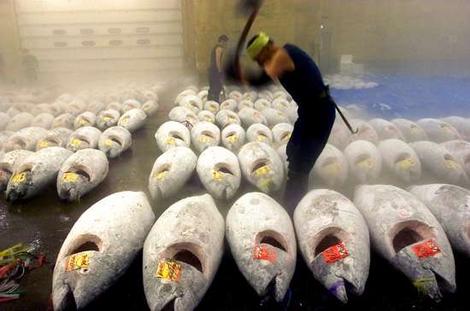
Bluefin Tuna In Trouble

Bluefin Tuna are in trouble. Their numbers have been decreasing due to over-fishing. It's gotten to the point where Bluefin Tuna are in such demand that the price for them is high. Just this January, a Bluefin tuna sold for 1.76 million dollars in Tokyo. That's a ridiculous amount, but it's because Bluefin tuna are integrated in many meals like sushi. Primarily, Bluefin tuna are used in Japanese delicacies like sushi and Japan consumes 80% of bluefin caught around the world. The largest players that catch them are Japan, South Korea, Mexico, and the United States. 


Just this year, they recorded that more than 96% of Pacific Bluefin Tuna are in decline. It's been a few years that Bluefin tuna are endangered, but as time goes on and as they reach critical endangerment, fisheries and tuna lovers will face hard times. The Bluefin tuna are being caught at their juvenile stage, before they can even reproduce. It takes between 4-8 years for Bluefins to reach sexual maturity. "Stocks of all three bluefin species —the Pacific, Southern and Atlantic — have fallen over the past 15 years amid overfishing" 

Here's a long article by the National Geographic that might put this whole theme of "overfishing" into perspective. 

Tuesday, October 29, 2013

News Tuesdays

News Tuesdays 

http://www.nytimes.com/video/science/100000002524020/sciencetake-what-makes-ticks-stick.html

To start of this weeks news Tuesdays, there's a very interesting short video about the tick. It's a video that shows how ticks stick to skin by bearing it's saw like jaws deep into the epidermis...

 Does it make your skin itch yet?
Carpenter bee     Sandra Rehan, University of New Hampshire
Moving on to more discovery type news, the BBC covered a segment that bees were extinct 66 million years ago, about the same time as the dinosaurs. What's interesting about this find is the fact that bees don't possess much diversity in their species... This might be a correlation with the extinction.  

A female epicephala moth pollinating a phyllanthaceae female flower
This is an interesting article touching on how female and male flowers have different senses that might give off different "rewards." This is interesting since the different sex flowers aren't as common as single sex.  They looked at epicephala moths and noted their behavior towards the flowers.

Monday, October 28, 2013

Coral Reef Bleaching- Underwater ecosystems in danger.

Coral Reef Bleaching


When scuba diving, you might have seen ghostly corals near the shoreline, this is mostly because the temperature of the waters in that area have risen. There are other factors that may play a role, but global climate change is the biggest contributing factor. Because of rise in temperature, the sudden change makes the corals stressed. When stressed the corals's algae leave them which urns then white. There is a vast amount of algae that are helping the coral survive. They help the corals produce food and photosynthesize. This change doesn't mean the corals are dead, but are stressed and on the verge of death. "In 2005, the U.S. lost half of its coral reefs in the Caribbean in one year due to a massive bleaching event." Corals have a limited range of temperatures they can live in. With global warming upon us, this exceedingly makes it harder for corals to survive since water temperatures are rising. 

So why are coral reefs important? 

Coral reefs house 25% of all marine life. Without corals, those marine life wouldn't have a house to protect them against predators. This decrease of housing could result in devastating population instability. Besides the ecosystem being in jeopardy,  it affects human jobs since the corals help support the fishing industry. 


Tuesday, October 22, 2013

News Tuesdays


IN RECENT NEWS..

Just last week, there was an Oarfish that washed on the shores of California. It's 14 feet and a deep sea creature. Once they autopsied the body, they realized it was pregnant at the time. It's just unclear on why the Oarfish died.
Australian scientists have found gold particles around the soil of eucalyptus tree's and in the leaves. It's interesting that precious metals like gold can be found in common leaves. "We've done a calculation, and found that we need 500 trees growing over a gold deposit to have enough gold in the trees themselves to make a gold ring," said Dr Lintern

Gold and other mineral deposits in leaf


There has been a recent discovery of a venomous crustacean. Out of the 70,000 species of known crustaceans, this remipede crustacean is poisonous. The remipede lives underwater and uses its poison liquefy its the prey.

Remipede